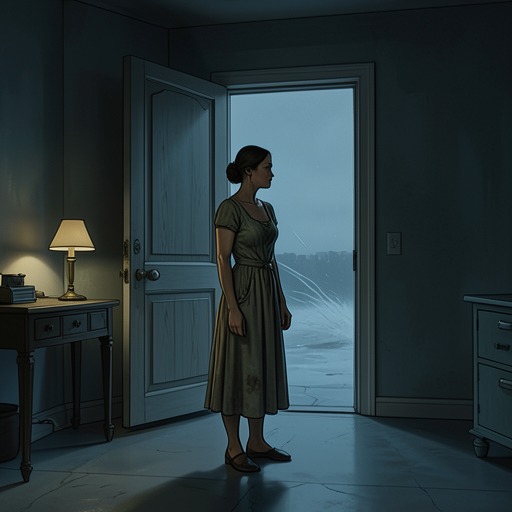
Amaia Salazar’s Trauma and Persistent Fear
Ofrenda a la tormentaAmaia Salazar’s trauma and persistent fear shape how she dreams, loves, investigates, and responds to bereavement. The past does not remain safely behind her: it returns as a nightmare of childhood terror and as a private fear she knows cannot simply be shared away. Yet speaking with James, receiving comfort, and listening to other people’s grief create points of contact with a world that the old horror cannot wholly reclaim.
The Wound and Its Return
Amaia’s childhood fear is first rendered through a dream that begins in a place of affection. She knows she is dreaming, and the bakery workshop appears as it was before it became a place of nightmares. Her father, in a white jacket, rolls pastry with a steel pin; the smell of butter fills the room, music plays from a small radio, and the child Amaia circles the marble table, happy to be alone with him. The remembered happiness matters: the dream restores the knowledge that she had once been deeply loved by her father, a fact she had nearly forgotten.
That refuge breaks apart without warning. Her father vanishes, the clean worktable and high windows give way to darkness, and the route to the door stretches into a long, curving passage. A small light remains in the distance, but the dream ends in blood and helplessness. A presence approaches the child, presses down on her abdomen, empties her lungs, and takes her remaining breath. The remembered words of Aloisius Dupree, who had described bleeding as a gradual loss of concern, enter the scene as the child accepts her dying state. Adult Amaia feels pity for the girl but also understands her; she leaves the child in peace rather than forcing the dream to resolve into rescue.
The nightmare makes trauma a recurrence rather than a completed episode. The bakery’s butter and pastry, once associated with the child’s happiness, are also linked to the adult’s present life with Ibai, whose scent has carried her into sleep. The transition joins tenderness to terror: a loving present opens onto an earlier world in which safety disappeared. The dream does not erase the good memory of her father, but neither can that memory prevent the scene from turning toward violence and suffocation.
Fear, Silence, and Intimacy
When Amaia wakes, James is beside her. He has watched her sleep, pulled a blanket over her, and leaned in to kiss her just as she opens her eyes in panic. She is frightened before she sees him, then immediately relieved. She tells him she was dreaming, repeating the reassurance she has used since childhood almost every night. James does not answer with an explanation; he stays beside her until she manages a small smile and he embraces her. His quiet presence offers comfort, but the repeated waking phrase also shows how long the fear has been part of her nights.
The fear extends beyond sleep. Amaia has kept a rule against discussing the details of police work at home, and she has also treated parts of her childhood as things best left unspoken. For years she concealed the past beneath an appearance of normality. When the barriers containing the horror broke and brought her close to madness, honesty with James became an opening through which light could enter and a meeting place between them. She associates that honesty with returning to a world in which the old vampires cannot reach her so long as she remains on guard.
She nevertheless understands the limits of disclosure. Fear, as she sees it, can withdraw but does not vanish: it waits in the dark, a small warning light that remains visible even when denied. Naming fear and showing it to another person do not make it cease to belong to the person who feels it. Amaia had hoped love might be enough to make opening herself to James sufficient; experience has taught her that intimacy can make room for fear without abolishing it.
That difference also shapes her understanding of James. She still sees the handsome, confident artist she fell in love with, whose comparatively sheltered way of looking at the world lets him believe that a person can turn the page, bury the past, or recover from fear through treatment and determination. Amaia finds that faith in chosen happiness difficult to share, and she knows he does not truly want the darkest particulars of her work or the unresolved horrors of her past. Yet she smiles before answering him because she loves him, remains fascinated by his outlook, and recognizes that loving someone also requires the effort to keep loving across differences in what each can bear to know.
Other People’s Grief as Witness
Amaia’s experience of fear is set beside Markina’s account of loss. When he was twelve, his parents’ three-week-old baby died. He remembers hearing his mother scream, finding her trying to breathe life into the child, and watching his father struggle to pull her away from the body. Her cries lasted for hours; afterward, she stopped speaking to Markina and his father except to ask where her baby was. She blamed herself, attempted suicide, and was admitted to a psychiatric clinic. Her grief, Markina explains, left her unable to remember that she was married or had another child.
The disclosure changes Amaia’s view of the judge. His polished appearance and control had seemed to her like a defensive perfection; his account exposes the pain beneath it. She recognizes in him a person who, like herself, has imposed strict control on the present to keep pain and stigma at a distance. His story does not make their experiences identical, but it gives her a more intimate understanding of the vulnerability concealed beneath his public composure.
Her investigative encounters with bereaved families likewise show how she responds when grief is dismissed or misunderstood. A priest tells Amaia that Yolanda Berrueta comes each week insisting that her children’s bodies are not in their grave. He believes her maternal instinct and pain are powerful, yet insists the children were buried there because he officiated at the funeral and saw the coffins lowered. Later, Amaia acknowledges that a mistaken identification of the coffins might have allowed Yolanda to be dismissed as confused, while the missing baby of another woman in Elizondo might also have gone unheard. Yolanda’s insistence proves consequential: the possibility that a child’s body is missing becomes evidence that must be taken seriously, not merely a symptom to be explained away.
Amaia’s promise to a bereaved man that she will catch whoever is responsible reveals another limit of her power. His partner has moved to be with him, only for him to be gone; Amaia vows to find the person responsible, and he answers that punishment cannot bring his loved one back. The exchange distinguishes justice from restoration. Amaia can pursue an answer and stand with the bereaved, but she cannot promise that either act will undo their loss.
Grief, Action, and What Remains
After the investigation’s violence and revelations, Amaia returns to Engrasi and cries in her aunt’s arms as she once did as a child. She weeps for fear, anger, bitterness, regret, what has been lost and defiled, and the pain of death, bones, and blood. Engrasi wishes she could keep the doors closed and let her girl cry out the world’s harms day after day. Amaia cries until she has no tears left; then she must be ready to do what she needs to do. The scene brings childhood dependence into the aftermath of adult violence: she is held rather than required to master her grief at once.
Action follows the crying, but not as proof that the grief has been cured. Amaia makes four calls and receives one. Her first is to Elena Ochoa’s daughter, to tell her that Elena did not die by suicide and that the letter she left helped stop the dangerous child-killing sect whose case has reached the news. The sequence links private mourning to public truth: after giving herself time to break down, Amaia resumes the work of telling a family what happened and ensuring that a dead woman’s warning is understood.
The novel therefore presents Amaia’s fear neither as a temporary obstacle nor as the only truth about her. It recurs in sleep, in the guarded boundaries of marriage, and in her response to other people’s losses. It also makes her attentive to the difference between grief and madness, between a promise of justice and the impossible promise to restore the dead. Comfort, testimony, and action can help her continue; none requires the claim that fear has vanished.